


Filed under: Uncategorized

Join us at OBSERVATORY, smudge studio’s geo | cosmo field station, workshop + tea hut, located at 158 High Street in Belfast, Maine.
Over the coming months, public events at OBSERVATORY will include:
– Public reading and library space including resources dedicated to ancient and contemporary observational practices: geology, ecology, art, land-use interpretation, Daoism, weather/cloud spotting, tea brewing and drinking, long life design.
–COSMOS DAILY window installations, free and open to the public, viewable 24/7 (also posted online @observatorybelfast)
– Collaborative observational and field note projects and events staged in conjunction with local Belfast and Maine organizations, individuals and businesses.
– Exhibitions of work by guest artists, educators, and practitioners curated through the lens of observations of geo/cosmo/planetary change.
-“Slow tea with the planet”: an evolving series of 30-60 minute long micro-productions and tea events that reframe the brewing and drinking of tea as a geo/cosmo event.
– Local landscape inspired, gluten free, vegan, chocolate “ledge cookies” that provide a material tale of the Maine bedrock upon which OBSERVATORY stands.
Filed under: Uncategorized

a pairing of MOUNTAIN MOUNTAIN MOUNTAIN Japanese tea + artwork
to share and appreciate gyokuro’s tea’s deep stillness and
build reserve, health, and community for the year to come
Our first taste of gyokuro tea literally stopped our conversation. In stunned silence, we took in the experience.
A pearl of sweet depth. Rolling softly along taste buds. Then gone. As though we had tasted a mountain just before it dissolved into a cloud-trace of minerality.
Gyokuro is translated as “jade dew.” When brewed well, the experience of it is brief but profound. A pot offers just a few sips. Intense ephemerality is an essential part of this tea’s aesthetic nature.
The geologic has been a core focus and passion of smudge studio’s practice for the past 15+ years. Drinking tea, we literally embody geologic forces of the cosmos: fire, oxygen, water, sunlight, earth.
And so, with much joy, we offer this pairing of an original smudge art work + a tasting packet of one of our favorite gyokuros.


We named this tea/artwork MOUNTAIN MOUNTAIN MOUNTAIN, after the nonagram created for our project, THUNDER³ : 002020.*
The I Ching’s MOUNTAIN trigram signifies stillness. Here, at the end of 002021, we compound it three times.
A packet of MOUNTAIN MOUNTAIN MOUNTAIN tea** is accompanied with an original 5” x 7” artwork.
DETAILS:
Each package includes:
— 25 grams of high-grade Yamashita Gyokuro from Maiko Tea, Kyotonabe, Japan. Sealed and prepared in Kyoto Prefecture in smudge studio-designed packaging. 25 grams is the ideal amount for three pots of gyokuro (approx. 8 grams each). Each pot can be shared among 1-3 people across 3-5 steepings.
— 5” x 7” print (each print is an original artwork and will vary in appearance from the images above):
- letter-pressed text excerpted from the changing lines of I Ching Hexagram #52, STILLNESS (translated by David Hinton)
- mountain-inflected image painted in grey acorn ink foraged from Prospect Park, Brooklyn cured with iron foraged from Provincetown, MA harbor
- linocut nonagram (MOUNTAIN MOUNTAIN MOUNTAIN) inspired by the I Ching.
—detailed brewing and serving instruction.
For this first release, 40 sets of tea + artwork are available. Please visit our website to place an order and learn more.
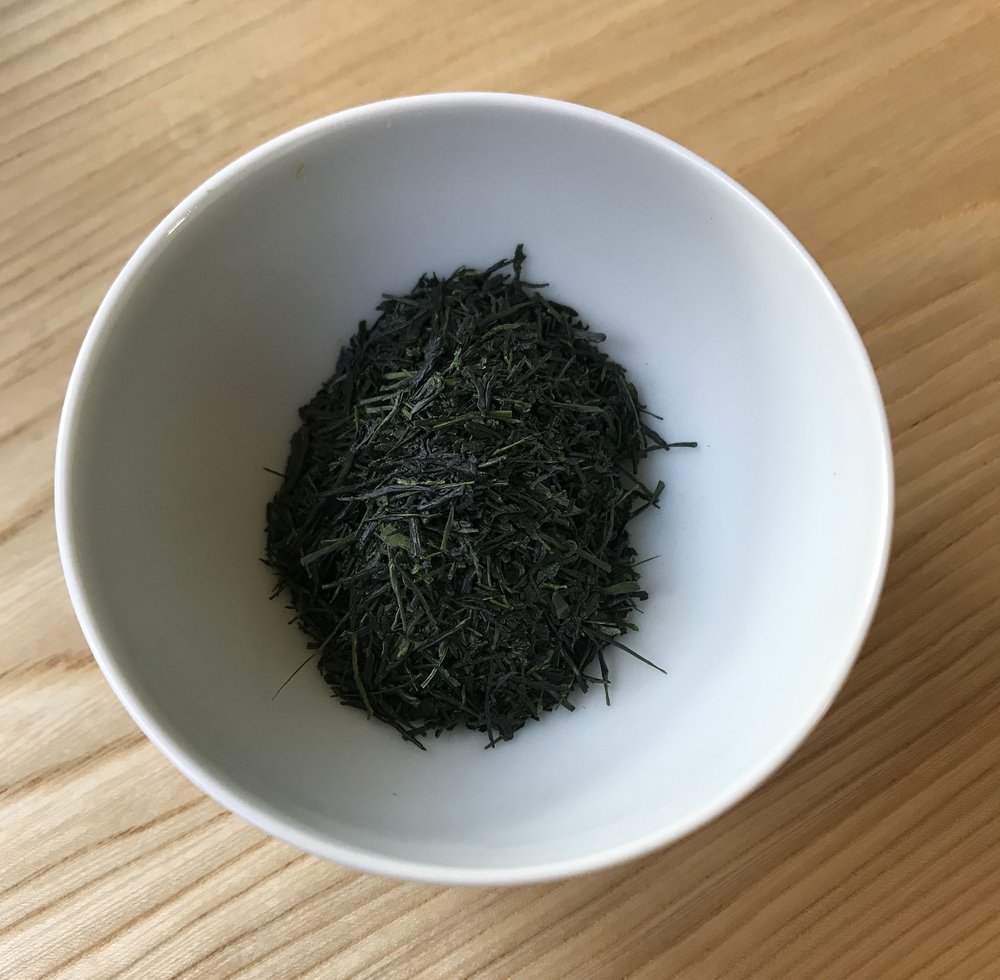
We invite you to enjoy your tea from a Tilt of the Earth 23.5º Teacup or a Long Life Design antique from Japan (in collaboration with Marie Uno).
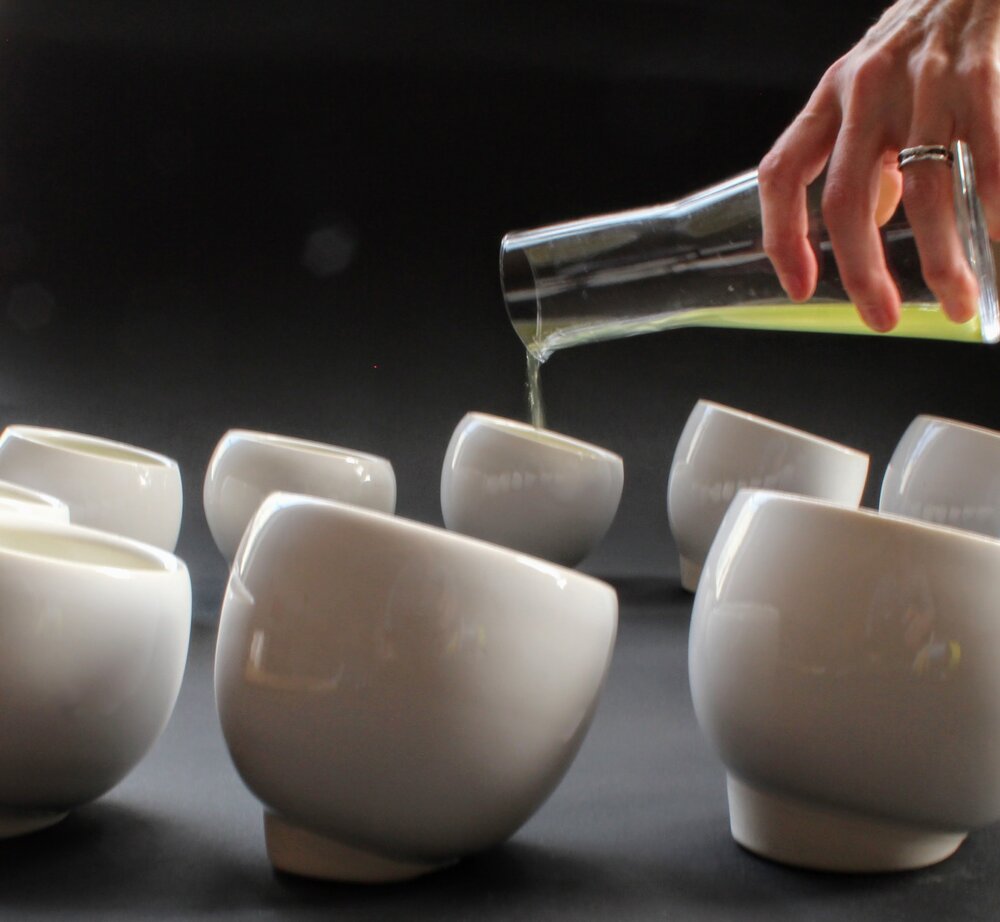

visit the Long Life Designs shop
__________
*THUNDER³ : 002020 draws from and builds upon the original eight I-Ching trigrams. For millennia, the I-Ching has informed humans of the necessity and wisdom of moving—with, and expecting—change. Quaking with imminent transformations to come, THUNDER³ : 002020 nonagrams signal the arrival of inciting forces of the physical universe during this time of massive planetary change.
**We visited Maiko tea in Kyotanabe, Japan, in 2008. Since then, we have been dedicated customers of this special cooperative in Kyoto prefecture. Yamashita Toshikazu of Maiko is a living National Treasure of Japan. His award-winning gyokuro has come to define this type of tea for us.
Filed under: Uncategorized

Join us for tea next weekend in Prospect Park. Jamie will be hosting an interactive micro-production, Drawing a Line to the Sun, as part of Nature Tea 2021 from 10-10:30am on August 15th. Learn more and get tickets here.

After completing THUNDER³ 002020 last fall, we experimented this summer with turmeric ink anthotypes and new letterpress tools. An anthotype nonagram from the THUNDER³ 002020 project is now on exhibit and up for (online) auction as part of the Provincetown Art Association and Museum (PAAM) 12×12 Member’s Exhibition, running from August 6-October 3rd. Proceeds are shared between the artists and the Museum. See the full member’s exhibition here and read more about the anthotypes here. Jamie has also been experimenting with how geo/cosmo inflected concepts and sensations might translate into watercolor forms. One of the first experiments in this process is also included in the PAAM 12×12 show.
As the summer winds down we hope you will enjoy these new sun works from smudge.
Filed under: Uncategorized
Just over two hours after sharing this post, Earth will pass through its aphelion — the farthest distance it will be from the sun over the next 365 days. At 6:27pm ET on July 5, 002021 Earth, will be 94,510,886 miles (152,100,527 km) from its star. That’s 3 million miles farther than it will be six months from today.
Continuing our Sunworker project, we used today’s cosmological “holiday” to experiment with visualizing the continuous force of the sun upon on Earth, our bodies, and all things as it shapes life, weather and geology in myriad ways.

Despite our greater distance from the Sun at aphelion, we are nearing the height of summer in the Northern Hemisphere and are experiencing some of the strongest UV rays of the year.* To visualize the intensity of the sun’s rays on this particular day, we created a home-made “UV strip” from turmeric ink and wore it directly on our clothes when we were outside. When we were indoors, we placed the strip on our Brooklyn balcony to catch photons as they arrived continuously.

Roughly each hour, we exposed an additional inch of the strip (to direct and/or ambient sunlight) resulting in a creative imaging of eight hours of the sun’s light as it accumulated on Earth between 7am-3pm on aphelion 002021.
The resulting anthotype is our first experiment in creating a wearable artwork that visually expresses one of the sun’s forces through color gradation. It is an imprint of the sun’s intensity on this day during the hours leading up to the moment when Earth reaches the farthest limit of our annual orbit.

Aphelion Anthotype, smudge studio 002021 (eight hours of the sun’s light as it accumulated on Earth between 7am-3pm on aphelion, July 5, 002021).
*On January 30th, 002020, we held a project to mark the coldest day of the year in New York City. The City’s thermal (temperature) maximum arrives on July 20th and is not related to aphelion.
Filed under: Uncategorized
Over the coming months we will share practice-provocations under the title of SunWorker. They will invite reader-practitioners to “inhabit ancient observation practices within the Anthropocene” in order to develop and activate awareness of their intimate entanglements with the Sun’s cosmological forces.
For more, visit the Sunworker project page on smudge studio.
DISPATCH #1:

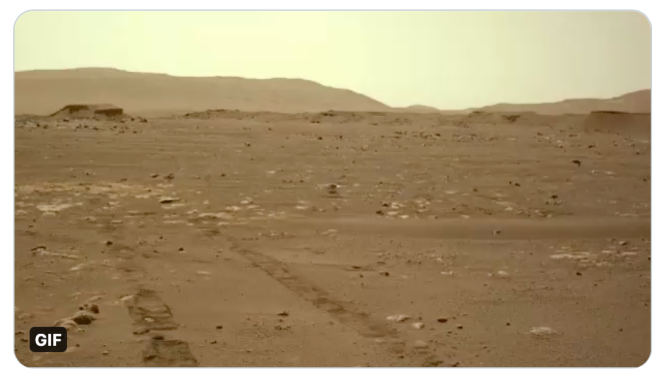 image via NASA Perseverance, sunlight on Mars April 8, 002021
SUNLIGHT ON MARS.
SUNLIGHT ON EARTH.
SAME SUNLIGHT.
It takes approximately 8 minutes and 30 seconds for photons from the sun to reach Earth.
It takes approximately 12 minutes and 30 sections for photos from the sun to reach Mars.
Filed under: Uncategorized
 DRAGON³, from THUNDER³ : 002020, smudge studio 002020, 5 x 7 woodblock print, hand-typed text
Of its own accord, a third I Ching trigram appeared within a human brain, and extended traditional I Ching hexagrams into the 21st Century.
That day, fires raged up and down the West coast of the United States. Over 6 million acres burned before the 2020 fire season even began.
FIRE over FIRE over FIRE.
The first nonagram.
It was the “anthro” burgeoning forth and co-assembling with, and in, elemental material conditions on Earth.
 FIRE³ nonagram overlay (base image of fires along the West Coast via NY Times/Mapbox)
Soon after, WIND over WIND over WIND emerged.
Typhoon Haishen gathered force in the Pacific Ocean. The first Super Typhoon of the 002020 season, holding sustained wind speeds of 135 kt (155 mph; 250 km/h). Within weeks, Haishen was out-scaled by Typhoon Goni (sustained 140 mph) and Hurricane Iota (sustained 160 mph). The 2020 Atlantic Hurricane season was the most active in the 169-year official record.
 WIND³ nonagram overlay (base image of Typhoon Haisen’s windspeed from Windy.com)
The stacking of three I Ching trigrams.
Unheard of.
I Ching nonagrams do not exist
There is no established way to “read” them.
An attempt to interpret their significance requires viewing them from within the foment of life in 002020.
Nonagrams, like 002020, defy capture by legacy ways of thinking and seeing.
And yet, here they both are.
Nonagrams. Contemporary life in 002020. THUNDER over THUNDER over THUNDER.
Forces of change intermingle, manifest, shape-shift.

Nested within the nonagrams are eight trigrams (THUNDER, FIRE, WIND, WATER, MOUNTAIN, LAKE, EARTH, DRAGON*). These are the dynamic roots of all 64, traditional I Ching hexagrams. The trigrams express eight elemental energetics that fuel ongoing transformation of the cosmos—as observed and storied by humans over 2000 years ago.
Do not be fooled by the spare appearance.
Trigrams quake with the imminence of transformations to come.
They signal inciting forces of the physical universe.
For millennia they have informed humans of the necessity and wisdom of moving-with, and expecting — change.
The graphic simplicity and spare grace of the eight trigrams render their readings infinitely ambiguous, withdrawn, adaptable, evocative.
Entirely abstract, yet indicating dynamics that animate every formed thing.
In their doings and undoings, the cosmos continues its formings and unformings.
The nonagrams presented here upend traditional stories of political strategy that are often associated with the I Ching hexagrams.
The composition of a nonagram is a shifting one—signaling Earthly interactions with larger, enigmatic movements of the cosmos.
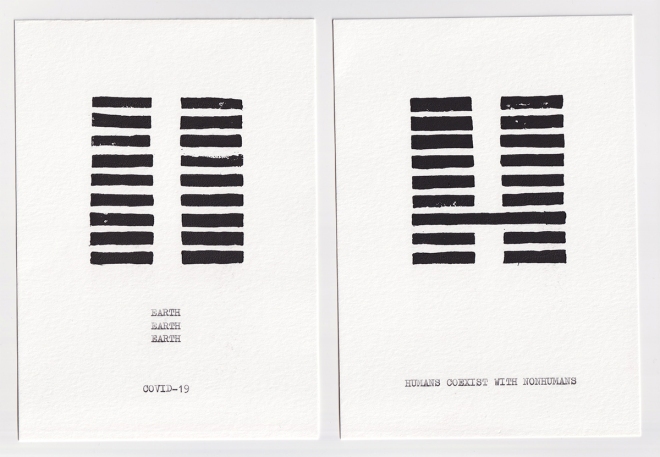
The project: THUNDER³ : 002020
It has been challenging and humbling to continue creative work this past year. Our engagements with ancient Taoist philosophy and practices gave us perspectives and means for responding to 2020’s new realities and their embeddedness within forces of planetary and cosmological change.
The result of those engagements is THUNDER³ : 002020.
A collection of works on paper (16 wood-block prints).
In which the forces of change represented by the original eight trigrams of the I Ching join with limit case human and planetary events of 002020.
Graphic design, poetry, visual stories offered from within human lives lived during a pandemic year.
Communications from the Tao—or preferably, and without separation—the Tao imaging itself.
The project consists of a series of eight pairs: 8 “002020 themed” nonagrams paired with 8 “karma’s wise return” nonagrams.
THE 8 002020 NONAGRAMS: Eight graphic, poetic sensations of compounding transformational forces. Image-sensations of 002020. Shape-shifting configurations of elemental materials. A respectful riff on the I Ching.
THE 8 KARMA’S WISE RETURN NONAGRAMS: Eight wishes and teachers taking shape out of the changes storied by the 002020 nonagrams. Glints of karmically re-shaped, potential futures. Invitations to unrealized wisdoms. A Taoist bow to transformation’s nuanced complexities.
The “002020” themes appear on the left, and the “karma’s wise return” themes appear on the right in each pairing.
THUNDER, THUNDER, THUNDER 002020 | 002021
WATER, WATER, WATER D. TRUMP | BLM/#METOO/ACTIVE CITIZENS
EARTH, EARTH, EARTH COVID-19 | HUMANS CO-EXIST WITH NON-HUMANS
DRAGON, DRAGON, DRAGON* NYC FEBRUARY 2020 | URBAN CO-ARISING DIFFERENCE
MOUNTAIN, MOUNTAIN, MOUNTAIN QUARANTINE/SOCIAL DISTANCING | LOCAL COMMUNITIES, PLACE
FIRE, FIRE, FIRE WESTERN WILDFIRES | NATIONWIDE CLIMATE CRISIS AWARENESS
WIND, WIND, WIND TYPHOON GION, HURRICANE IOTA | GLOBAL CLIMATE CRISIS AWARENESS
LAKE, LAKE, LAKE ZOOM | LIVELIHOOD ASPIRATIONS RECAST
Filed under: Uncategorized

Uncertainty. Tea leaves. Texture. Water. Sound. Temperature. Time. Scent. Color. Flavor. Transformation.
Elements and sensations co-mingle. The constant remakings of our bodies, planet, the universe. We prepare for tea. We bring mind into focus: gather utensils, tea leaves, prepare space, water. We make tea. Note temperature, the color of dry leaves, see thin leaves fall into a teapot, watch flowing water. Time, tea and water co-mingle and transform. Wait, pour. The rising scent of wet tea leaves, darkening shades of green. Taste. Alchemy — parts of us becoming the chemistry of tea: tannins, L-Theanine, sunlight, time. Pause, swallow. We are materially transformed, linked to tea plants, time and season, humans and labor, sunlight, earth, universe.
Sensations arise with our bodies’ material interactions through time. Then dissipate.
During July 002020, we staged Tea #8 and Tea #9 of Tea in the Dark: Koans for the Anthropocene five days apart. These ongoing iterations of Tea in the Dark use practice to explore tea’s capacity to transmute vast scales and cosmological forces of elemental change into intimate, embodied human experience. They aim to re-weave our modern consciousness into cosmological rhythms of continuous transformation. We experience this re-weaving as a deeply ecological act.
Tea practices have aided humans in sensing themselves as being interconnected with the cosmos and attuned–or disharmonious–with it. Such awareness can deepen our collective ability to grasp the fact that our species’ existence on this planet is precarious and unpredictable. It can invite creative inhabitation of ever-changing planetary conditions.
Teas #8 and #9 activated tea as a medium of hospitality and for contemplating cosmological co-existence. Preparing, sharing, and drinking tea can be a skillful means for drawing vital nourishment from elements of our world that compose and sustain us—while connecting us with one another. Both of these projects occurred online. But we felt that the contexts of sharing tea linked us intimately with friends and strangers across the North American continent. Guests received analog, material component for both projects (a postcard for Tea #8, and mailed canisters of tea for Tea #9).
TEA #8 This Time With Tea, July 25, 002020, in collaboration with Make it With Tea and Summer Tea in Prospect Park 2020 (August 15th, 2020)

In late June 002020, we began to plan for our upcoming project in collaboration with Make it with Tea. We threw three coins six times to construct an I Ching Hexagram. The result was Hexagram #45: Composure/Gathering Together. We began here, imagining how we might stage Tea #8 in ways that induce us to individually and collectively “concur with all things, abide in everything gathered together.”

The I Ching (Book of Change) dates to around 1000 B.C. For us, the texts and images of the I Ching are creative reminders—voices from an ancient consciousness of our species’ evolved ability to sense its interconnection with the cosmos. And a provocation to use that consciousness to attune to the ways of the cosmos and use them as guides for navigating change.
Tea preparation and tasting (earthenware utensils, water, tea leaves, time etc.) are embodiments of material transformations that the I Ching witnesses. Its text and images are endlessly evocative. We consulted its wisdom on the fundamental principles of reality, and found hints for how our micro-productions might “maintain the proper relations between heaven, earth and humankind.”
We posted information on smudge’s website for guests attending the tea and for those interested in learning more about the I Ching.
All things (photons of sunlight, the movement of nuclear waste, human bodies, tea, viruses, hurricanes etc. etc.) are configurations of fundamental dynamics of reality’s continuous unfolding. The temporary states of reality’s materials and forms configure, dissipate, reconfigure. Change continues on, reshaping the world.
When we make and drink tea, as when we act in any way, we move within and alongside the transformations that the I Ching maps. Each tea time is a transformational process that occurs only once. That profound fact is tea’s vital nature. It is alive with its unique difference and unrepeatability. Each sip of tea is the manifestation of singular materials, circumstances, and vital energies that are co-created and exchanged by its participants.

We staged Tea #8 5, 2020, as a seven act micro-production for “eco-cosmological being.” We gathered online with six collaborators to drink tea and co-create an I Ching Hexagram. This collaboratively arrived at Hexagram would be imbued with the energies and conditions of the people, places, and moments playing out on the Zoom screen. The seven acts were:

For This Time with Tea, we did not approach the I Ching as a form of divination. We activated it as a practice for reintegrating ourselves (as individuals and groups) into the generative, unfolding tissue of existence — while the many planetary uncertainties of the Anthropocene and COVID-19 unfolded around us.
The Hexagram we arrived at together was #60: Pattern.
We then used Pattern as inspiration to design and produce image-sensation postcard artworks—transpositions of the unique, singular forces at play within the group’s shared time together.
Materials for the postcards included a stamping of “patterns” made from rose hips (used for the Tea’s ikebana arrangement), along with iron, green tea and watercolor. Each postcard included poetic excerpts from Hexagram #60’s text.


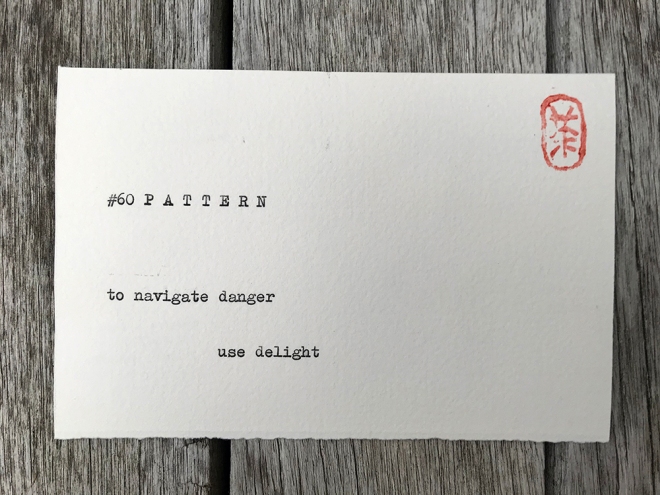


We mailed the postcards to participants of Tea #8 as a gesture of ongoing connection, and invited recipients to activate their postcard as they wished. For example, those who are able attend the upcoming Summer Tea in Prospect Park 2020 on August 15, 002020 could use the postcard to help them contemplate the unrepeatable context and collective action(s) of that event.
TEA #9, Alchemy of Uncertainty, July 30, 002020, in collaboration with the Alcyon Center, Maine

solar can print (365 suns) from June 21, 002019- June 21, 002020, Provincetown, MA, smudge studio
June 21, 2020, marked summer solstice in the Northern Hemisphere. Global cases of COVID-19 passed 30 million on June 28th. On July 4th, Earth was at perihelion in its orbit around the sun. July 14th marked the 75 year anniversary of the Trinity test of the first atomic bomb in New Mexico. July 13-23rd, the Neowise comet graced night skies on Earth while on its 6,800 year orbit around the sun — a circuit it’s been making since the birth of our solar system.
Our awareness of material change—our sensations of transformations arising and falling away—are the sum total of our life experience. Because of this, our ability to notice, learn from, and find joy in transformation is of great consequence. Such awareness doesn’t always happen easily. We often need to strip away habitual thoughts and ossified verbal descriptions of what we think things “are.” Transformation can be subtle and enigmatic. And yet, we can often glimpse it through readily available visual sensations—scent, touch, flavor, sound—as they pass into and out of awareness.
 7 grams of green tea were sent by mail to each guest in advance
On the afternoon of July 30, 0002020, we guided seven guests through a shared aesthetic experience of elemental transformation. The moment to moment process of observing the transformation of tea leaves into a cup of tea, and then into our own bodies, unfolded in “ten acts.”
First, we introduced the 8-minute cold brewing method that we had designed for our chosen tea (Ayame Kabuse sencha).
To further set the stage, we shared Lu Tong’s poem about the wildly transformative effects that tea had upon him, over 1000 years ago: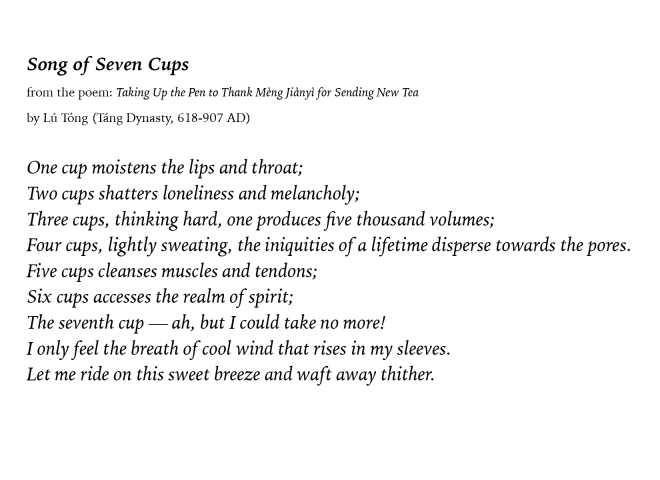 We then made tea in slow motion while aligning awareness and sensations with the unfolding transformations, and uncertainties, taking place in our singular shared time of tea-making. Rather than relying on thoughts, memories, or feelings to contemplate elemental transformation, we focused on our immediate, fleeting sensory experiences. We noted mingling, changing sensations of scent, texture, color, sound, flavor as they arose and fell away. The making and drinking of tea was punctuated with moments of silence, artistic response, and reflection.
The life and art of our favorite, humble tea monk, Baisao, provided further inspiration during the micro-production.

Sipping tea together within times and conditions of radical uncertainty, we considered the power and vitality of the simple, hospitable act of sharing tea.
*additional details for both Tea in the Dark #8 and #9 can be found on the Digital Chakaiki 茶会記 tea record
Filed under: Uncategorized
 an everyday tea set-up for FOP/smudge studio
Making, sharing, and drinking tea has been a daily practice for us for many years. The ongoing pandemic has given it a new valence.
A few weeks ago, the “daily life” surrounding our familiar morning tea routine turned entirely unfamiliar.
From the outside, it might appear to be the same: tea happens after breakfast and before starting our work for the day. But activities on either side of tea have been reconfigured entirely, and continue to change — from how we procure the food we eat (via vast distant national networks rather than the local Brooklyn food co-op) to the nature of daily work and communication (now almost entirely online).
Everyday actions in domestic space have come to comprise nearly the entirety of life. Over the past month this has become a global reality. Actions that support the dailiness of life (food sourcing and preparation, health care, basic transportation, exercise, hygiene) have earned a new name: “essential services.” Many such services were counted as “domestic work” a few months ago. In many ways, there is a renewed appreciation and acknowledgment of the labors that support healthy human life, and that must be renewed over and over on a day by day basis.
During the recent “stay at home,” we have lost track of linear time, often wondering what day it is. Simultaneously, we have grown more attuned to the sounds of birds, cleaner air, the coming and goings of clouds, the necessity of sleep, the preparing and sourcing of food — the everyday.
With less ability to move, make, or do freely beyond the very local, it has become more apparent how many of the actualities and essentials of the everyday are contingent on the non-human world.
 gyokuro tea leaves, day 4, FOP/smudge studio
We’ve also realized that many of the lived, material realities of the pandemic have emerged “without and beyond reason.” There is no quick or simple way to “figure this out.” The ongoing pandemic is an evolving situation with seemingly infinite factors and vectors in constant motion.
All of this has made it clear that we do not need Reason—or a reason—to appreciate the enigmas of daily life. Nor to drink tea. Daily drinking of tea is an occasion for embodying and experiencing aspects of “the everyday.” The everyday doesn’t need a reason. It simply is.
These realizations compelled us, in the midst of the pandemic, to continue our Tea in the Dark: Koans for the Anthropocene project and stage Tea #7, Tea without Reason.
We felt that this tea has a particular power to activate the original intention of Tea in the Dark. Reason alone will not guide us through the uncertainties of the days and years to come. Much of what will come is unknowable from here. We will pause with this “darkness” in the light of each morning, to have tea without reason.
Duration felt important. We decided to take a full eight days to learn what we could from this tea event. We also felt we needed a guest and a context to help us hold the everyday meaningfully and with intentionality. So, we invited a dear friend and artist from Guelph, Ontario, Lisa Hirmer to “join” us in the process over the week. The parameters were simply to have tea each day, without any further reason. We would meet on online at the end of the week to share the final daily tea and discuss what unfolded.
What follows are notes and reflections documented from within the process between April 25th and May 2nd, 002020. Further details can be found on the Tea in the Dark 茶会記/chakaiki, tea record.

eight days of tea, from Tea #7, Tea without Reason, photo: Lisa Hirmer

eight days of tea, from Tea #7, Tea without Reason, photo: smudge studio
April 25, Saturday Tea #1 smudge studio (ss): albino sencha (no spills) / Lisa Hirmer (LH): Japanese sencha (left over from an old project)
ss: Provincetown, MA, 7:50 a.m., sunny, 40s, calm wind. Black clay teapot. There is a pull outside because of the bright sun and low tide (at 7:40 am) , a planetary pull. Tea is shorter and more unfocused than usual due to this pull and attempting to align with the forces beyond the human. Time outdoors is more seductive and sacred than a few weeks ago. First pour is watery. Second pour is richer. Talk over tea: planning a day offline tomorrow (there were many Zooms this past week), listening to Stephen Bachelor’s Art of Solitude
LH: Guelph, ON, bright blue sky, wispy clouds, late morning, blue speckled teapot, old lavender mug, no spills. I notice that the sound of traffic at the intersection down the road has gotten louder again after weeks of being uncharacteristically quiet–a measure of a world gone slow. As news of reopening picks up, so does the noise. At this point the provincial government is only beginning to plan a future reopening and it will take a long time for any reopening processes to change my day to day reality, but I feel this change. It is something more than the intrusion of slightly annoying noise. It’s the context of the energy around me. The atmosphere matters. The tea is astringent but it is welcome.
April 26, Sunday Tea #2: Ayame sencha / Japanese sencha
ss: Cloudy, many bird songs. Black clay teapot. Preparing to “virtually” sit meditation with Ayano in NJ and ZMM (NY) after tea. The everyday is without reason. The everyday is with no reason, it follows the propensities and happenstances of each day. The everyday IS the daily forces at play. It is humble because it is tempered and shaped by the forces at play, even as our activities humbly shape those forces. Talk over tea: started watching Bella Tarr’s seven+ hour film Satantango last night, and it is reshaping life in beautiful ways.
LH: grey day, but no rain, late morning, same sencha and teapot. Dark grey mug, some small spills. Today it is much harder to focus and be with the moment. I struggle with the desire to make this daily tea practice into something more deliberately “meaningful” in a way that is pre-considered for how it could be presented to others. But I come back to the invitation. Not having a reason is important. With a reason I could distract myself from the unique hardness of this day. Without reason things take on a different meaning. I feel a pull towards ritual and wish I had special cups for this task…some kind of tactile cue that this is something in particular.
April 27, Monday Tea #3: Maiko gyokuro (lots of spillage) / Japanese sencha
ss: 9:10 a.m., rainy mist, windy gale, grey blanket sky, no bird songs. Black clay teapot. There is nothing everyday/mundane about the everyday. There is no end in sight to the virus. B train stops running in New York. This is our local train. Will it ever resume? There is rather intense wind and rain/gale today. The everyday is excruciating, focus is impossible. Happenstance: luck/fate+circumstance/surroundings. The wrapping of forces in play around one’s position—the luck and fate of where we happen to be. First pour is perfect, second pour is watery. Talk over tea: Recalling many things, such as our visit to Rice University hosted by Cultures of Energy/Roy Scranton several years ago. The abundance of academe at that time. The current crashing out of global economies.
LH: bright sky, a few clouds, early afternoon, same sencha and teapot. Owl mug, no spills. Again, focusing on the moment is difficult. My mind drifts towards a thousand practical things that need doing. With the reopening looming something becomes harder…an unknown date of shift feels more difficult than an indefinite stretch. I am grateful for what it means and welcome the lifting of difficulties so many people face right now. But, there is a part of me that longs for the quiet to continue. A measure of the relative, fortunate comfort I have, definitely. And also a surprise.
April 28, Tuesday Tea #4: Takumi gyokuro / Organic Green Ceylon
ss: 8:40 am., cloudy, windy, grey and white clouds, low and billowy. Past the rush, despite grey skies, lighter feeling after torrent / cathartic breakdown night. We chose a “special” tea for today. Daily life is “special” and worth celebrating, we welcome back the “old” familiar taste of Maiko’s gyokuro. Talk over tea: Just finished Zoom session with student in Turkey at 8:30 am. First seemingly real news/reporting about possible vaccine in September. The local is much closer now, we are attempting to slow down out of necessity. This afternoon we will finish watching Satantango before our online Chi Gong class “in” Brooklyn.
LH: dark skies, heavy air, storm coming,morning, organic green ceylon tea, arrived in the mail yesterday. White speckled mug.Today I am hungry for the moment of introspection and do the tea earlier than planned. The morning is filled with the uncomfortably still air of an arriving storm. The tea feels very interior, the world almost absent. I am missing a feeling of growth or maybe just movement. I think it is a process to learn how to live with stillness, or at least growth of a different kind. Or what about retraction? What would it be to retract in a world so governed by exponential growth? I challenge myself to think about this in a very real way.
April 29, Wednesday Tea #5 Ayame sencha (5 pours of tea + sunlight) / Japanese sencha
ss: 8:45 a.m., sunny, calm winds, soft blue sky behind white and green blossoms. Black clay teapot. One million+ known virus cases in US. Now “hooked” on watching each day’s spring changes arrive. The everyday is a fast cycle of returns, and yet each return is so different, especially in the transitional time of spring. First pour is filled with umami. Talk over tea: what food to attempt to buy online today, as there were many empty shelves at local Stop N’ Shop this morning.
LH: grey, cloudy skies, late morning just before lunch, small mug from the back of the cupboard, last of the sencha. Day 5 is a day of escapist daydreaming and distraction. Maybe I should plant a garden? Google nurseries and shade plants. It’s hard to just stay in the moment, there isn’t enough traction. What happens exactly today doesn’t feel like it matters. Even though this day is so specific. I think about how to introduce textures into the day. Schedules? Or is this an important part of slowing down into nonlinear time, these days of no texture? Tea was too strong.
April 30, Thursday Tea #6 Miyabi sencha (no spills) / Organic Green Ceylon
ss: High grey cotton ball clouds, 40s, 17 mph winds. White ceramic teapot. Seventeen students in online class starting later this month. Overwhelming tasks ahead — entirely online. Feels like a receding horizon to be able to pause with the quiet outside the door. How is it possible to feel and actually be, more “busy” despite going nowhere? First pour’s taste is sharp, bright, tangy, and changes to more umami as it sits in the cup. Quiet, slow, this everyday rhythm is becoming a rocking bough of ease and unknowableness, with flashes of joy. Talk over tea: preparing to talk to student in Shanghai at 8am, what is our schedule for the day?
LH: grey skies, light rain,early afternoon, another old mug from the back of the cupboard, big spill. The reality of how long this pandemic could stretch feels real today after receiving a cancellation, though I knew its arrival was inevitable. I drink tea with this sense of expansiveness. Feel something that I can only describe as a desire to build something, a way of being with each day so it doesn’t slip away. I get distracted by shopping online for a new desk clock. Spilled tea.
May 1 (Beltane), Friday Tea #7 Miyabi sencha / Organic Green Ceylon
ss: Splattering rain, grey blanket skies, wind and blossoms. White ceramic teapot. The EVERYDAY is strange, unknowable. Work/life has been vastly rearranged, and yet we don’t leave the house. Mind is preoccupied/busy/full. Much more livelihood “work” during these days, in stark contrast to the growing rates of unemployment. May Day blossoms: green, grey, yellow/green. We’ve taken to having two teas each day, one in the afternoon as well as in the morning. Talk over tea: FDR, logistic of manufacturing vaccines
LH: bright sky with big bright clouds, late morning, green ceylon, lavender mug again. No spills. I return to sitting on the floor as I did for the first few teas, I like this cue for opening a different space for thinking. There is so much time for thinking these days, it becomes a way of making this moment different. I realize that the cues that pulled me through the days before are missing: the shift in noise that happens between 8:30 and 9 am, the feeling of Monday, the journey to my studio. But I have become attuned to new ones (which are perhaps old ones): the light of the morning, the setting of the sun, hearing people walk by, my dog insistent that we should sit on the couch together in the evenings. But rather than pulling me, I have to look for them.
May 2, Saturday Tea #8 Ayame Sencha / Organic Green Ceylon
LH: bright sky but covered with field of small clouds, same teapot, white speckled mug
ss: 10 a.m. tea with Lisa. Brilliant sun, many birds and blossoms. Black clay teapot. One of us arriving to this day from a place of deep exhaustion and screen/logistical fatigue; the other from alternating fogs of not-knowing and clarities of “just this,” and yet:
Talk over tea together via Zoom: Original face koan, what cues make a day “worth” living. The monastic nature of these days. The difference between life as an artist in Canada and the US. The quiet, the vibration that human existence causes — how this affects all of us and every other being. How artists can meet this moment/context. How the process of sharing the tea with one another made what we consider the “everyday” more noticeable, and that all we have is the everyday — and the “everyday” of life co-existing with the changes wrought by the virus means infinite things, but makes what we do each day all the more vital and nearly impossible to take for granted.
The externally imposed/expected daily markers of “what makes a day” have shifted — our own activities and sensibilities become markers of this “having been a day,” or “making up a day.” The “daily” is a relatively rapid cycle of “returns.” It’s not the longer cycles of the seasons or years. The daily is more “human” in scale. “A day” is met in the midst of its own arrivals — not in the abstractions of seasonal or long term goals and anticipations. So many of the markers of the everyday happen “for no reason” — just eat; just sleep; just dress; just wash. This makes the everyday feel less populated with our own human projections of plans and expectations—more real, more immediately emergent “in the midst.” Without reason, everyday activities somehow become more meaningful, in that their meaning arises from within themselves rather than from some external function— and this feels like ritual. The affordances of utensils and cups, the experiences of using them deliberately and the embodied cognition in the moment. We wonder how/whether these practices will continue without knowing the other is doing them as well.
Filed under: Uncategorized

“Even after the most exhaustive and accurate scientific or philosophical account, the most compelling mythology, or the most concise and penetrating poem, the ten thousand things remain, in and of themselves, a mystery beyond us… For those artists and monks and writers, the sage lives most authentically on the edge where language and identity weave into the ontological tissue of change as a whole. Aren’t we each another fleeting forms in that tissue’s process of perpetual transformation? they might ask. Isn’t our fullest identity that issue itself? Isn’t it all and none of earth’s fleeting forms simultaneously? … to return to the origin place where heaven and earth interact in that all-encompassing generative present, to our own primal origins, our place at the wellspring of change. It is, in fact, to become dragon again.” – from Introduction, I Ching, The Book of Change, David Hinton
A ring of twilight moving slowly across the planet’s surface. Earth is half light, half dark. Today, and again in six months, a magnificent occurrence: the sun will deliver equal lengths of day and night to everywhere on Earth for an immeasurable instant. At 11:49pm ET tonight days will lengthen into spring in the Northern Hemisphere, and shorten into winter in the Southern Hemisphere.
To the wind, trees, insects, and birds, this day brings incremental differences compared to yesterday, as another spin of Earth continues their evolutions. But human systems are in a state of rapid transformation today as the circle of twilight between day and night passes over emptied streets. The sped up “now” of human life is, ironically, manifesting as an unprecedented slowing—a turning, literally, to the inside.
Two weeks ago, when our long-held plans to gather with family in Los Angeles were cancelled, now feels like two years ago. At the time, it was hard to accept that cancelling was actually necessary. Yet, each moment since has proven that it had been. This personal disruption is has now rescaled and compounded into a much larger, planetary sea-change of uncertainty. Its bitingly existential force has been humbling. The need to cancel more and more of what we once thought of as “life” and “our” plans is just beginning. Daily life, work, and routines that used to constitute the “everyday” are upended. We all will be, and already are, gaining previously unimagined new skills.
Signs of spring in New York City appeared over this past week. Their gentleness feels entirely out of sync with the uncharted territories that millions of humans are entering. We can learn much from the non-human world during this time. What species doesn’t face existential threats? The appearance of COVID-19 is linked to the material realities of the Anthropocene (travel, population densities, habits of consumption). The crisis will not be over soon and its impact will be felt and lived for years, as presumed in a MIT Technology Review article. Elizabeth Kolbert has long shared great wisdom on the realities of the Sixth Extinction. Roy Scranton shared a prescient and important wake-up call more than five years ago. Recently, trend forecaster Li Edelkoort speculated that our experience of the pandemic could, “eventually allow humanity to reset its values.”
In reality, no one knows what’s going to happen next—or how. The vast and complex intermingling of forces now ramifying will continue to accelerate changes that are inconceivable from here, though not entirely unexpected. (How some of us have been so lucky for so long?)

As artist|humans, we continue to sense that along with more responsive health care systems and priorities, philosophical and spiritual practices of change could be incredibly useful in our efforts to navigate the coming days with as much grace as possible.
When describing Zen Buddhism, Joan Halifax has spoken of cultivating “the capacity for the inconceivable.” Just a few weeks ago, our Qigong teacher in Brooklyn was kind enough to share a breathing practice with us. She framed it with the words, “it’s always good to practice the impossible on a regular basis.” Her words resonate more deeply today as we realize how little we can know about what is happening. And yet, in our state of unknowing, it’s essential to also realize that we each still have influence.
As we spin into a future that is changing unpredictably, the fact of our vibrant interconnectedness offers deep (if sometimes disturbing) meaning and vital purpose. Rather than attempting to resume life as it was (and it was never “normal”) as quickly as possible, we can pay attention to the change’s call to change with it.
The presence of unexpected and immediate existential risk can make personal actions and choices highly charged and memorable. Loosening our grips on habits of expecting stability seems to be a matter of great urgency now. It’s something we will be “working” on, from home, from within. Having the fortitude to find ways to still ourselves and observe, as in the Zen practice of sesshin, might be one of the most “healthy” things we can do for ourselves and each other in the weeks to come. Not carrying on as normal, needing less. Not filling every moment with the now alarmingly myriad opportunities to join Zoom groups around the world, every hour of the day.
Our collective actions in the weeks ahead will not only alter the course of the crucial next decade on Earth and shape the long-term future for all humans to come—they will also shape how the change is lived and experienced by every one of us, and those who come after us.
What is the moving balance we will each aim for in our lives? What solace might limits provide?

This morning at 11:30am ET, in the absence of the ability to be together physically, we gathered with family virtually, and co-created Tea in the Dark, Tea #6, Moving Balance: Practices for the Inconceivable (Spring Equinox). We staged Tea #6 of the Tea in the Dark project in preparation for the equinox that is arriving today and to create an opportunity to pause and observe. The moment of 11:49 am marked twelve hours before equinox, when light and dark will come into a fleeting equivalence across the entire planet. Separated by over 1000 miles, together we drank from Tilt of the Earth 23.5º Teacups.

Matcha tea from Kettl Brooklyn was drunk in Provincetown, MA, and Irish Breakfast tea in Urbana, Illinois. Poems and readings were shared, see our digital Chakaiki for full transcripts.


Tonight, all humans, even those separated by thousands of miles, entirely different perspectives, and highly unequal circumstances, will pass through a shared moment of moving “balance” that is integral to our species’ physical embodiment and evolution on Earth.
Drinking Tea #6, we were not aiming to sustain equilibrium, but to create an event of living within a moving situation. Despite our geographic distance from one another, at the scale of the planet, we share the material fact of the equinox equally. This moving moment, the hinge of seasonal change, “lasts” for zero seconds and for infinity. Because of this, this illusive event of “balance” cannot be inhabited. But it can be appreciated, noticed, and creatively responded to together. This spring’s equinox, we pause with the ongoing change that is the fabric of our very existence.
Filed under: Uncategorized
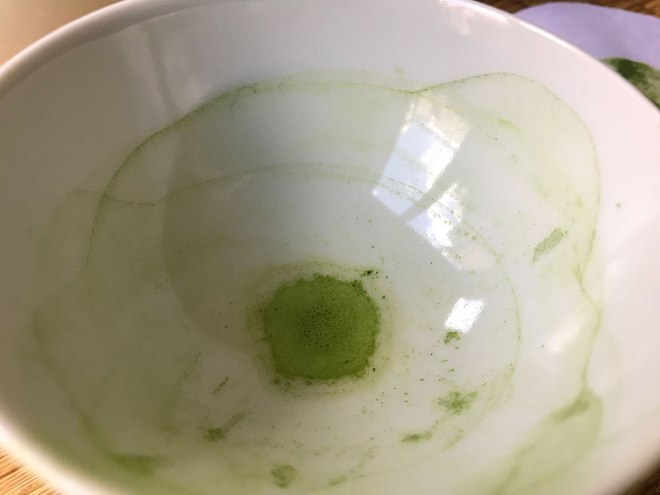
 “Pattern penetrates everywhere. But a bitter pattern won’t be inexhaustible… To navigate danger use delight… Heaven and earth are made of pattern, and so the four seasons come to completion. If you establish laws using that same pattern, you won’t wound prosperity of injure the people.“- Pattern #60, from the I-Ching: The Book of Change, translated by David Hinton
Human Standard Time appears to flow in a predictable pattern. Birthdays arrive each year on their pre-given, designated calendar day. So do most holidays. We can make plans far into the future because we know that if we sign up for a class, or trip, or schedule an event, on say, March 21st, 2022, we and others will converge when the calendar tells us that day has “arrived.” Leap Day’s anomalous appearance last Saturday led us to consider what makes such temporal alignments possible for humans — and what gets lost along the way.
The link between the Gregorian calendar and the movement of our Earth around the sun is calculated to afford all kinds of human coordination and communication. Linear clocks and calendars attempt to impose uniform, repetitive, predictable “time” onto the universe’s non-repetitive, ongoing flow of change that remains a mystery to modern scientists. Time isn’t a “line” that we and the universe’s events ride upon. It is the duration that it takes for an event of change to unfold.
As things and beings interact, they form and deform each other. Sometimes this is visible and sensible to humans. What we humans experience as “time” is actually our subjective experience of the duration of a particular change that we are watching or living out because it happens to be relevant to us. The earth rotates on its axis and there is a duration to it. We call one complete rotation a day and, culturally, “measure” its duration as being approximately 24 “hours.” The earth travels in an orbit around the sun, and there’s a duration to it. We contemporary humans measure the duration of one complete orbit as being about 365 “days.” A tulip grows, blooms, dies back, and hibernates. Its transformation has a duration. We measure the duration of a tulip’s cycle of transformation with the concept of “seasons.”
Though Leap Day might feel like a “bonus” day, the real bonus is to realize time doesn’t exist as a separate thing or force outside of or beyond the universe’s continuous process of change and movement. Time ultimately escapes our attempts to measure it, because there is no such thing as “time” for us to capture. It is our subjective, human experience of the duration it takes for something to change place from here to there, or to change form from what it has been to what it is transforming into.
No clock actually exists that is capable of “keeping” time in any absolute sense (see here for scientific explanation) because no two clocks exist in the exact same conditions or moving point in space/time. As Einstein discovered, that means no two clocks ever achieve perfect synchronization.
The “clock” of the earth’s movement around the sun is “out if sync” with the “clock” that is the Gregorian calendar for another reason. Unlike the Gregorian calendar, with its gridded, repetitive durations of days and months, Earth’s journey around the sun is irregular, ungridded, and non-repetitive. Each orbit (“year”) has a different duration than the last one, and the next one. Adding a day to the calendar on Leap Day is our (perpetually unsuccessful attempt) to re-sync the Gregorian calendar with the Earth’s orbit.
In a previous work (“Times of the Leap Second” in Living Deep Time Calendar Year 000001), we found the idea of Leap Day to be a fantastic, if not absurdist, example of how arbitrary human conceptions of time can be. And this year, we found it to be a worthy reason to stage Tea #5 of Tea in the Dark — differently.
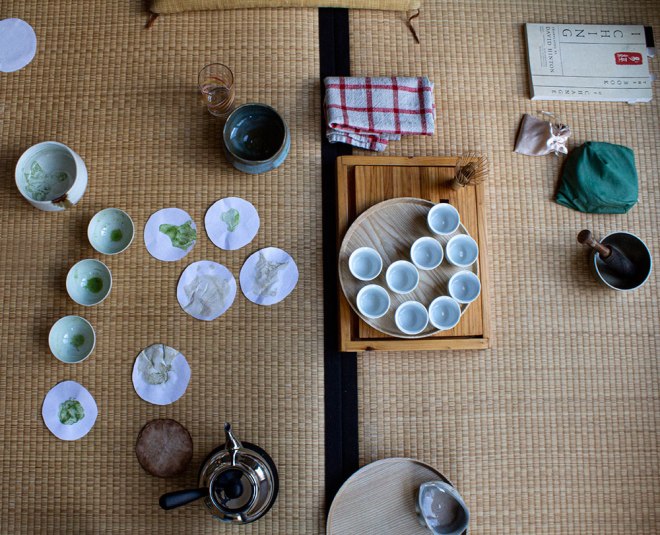
To begin to imagine how we might stage tea #5, we threw three coins in the tradition of the I-Ching (The Book of Change). The result was hexagram #60: Pattern. There were three changing lines in our throw, which resulted in hexagram #1 Heaven. Combining excerpts of David Hinton’s translated text for these two hexagrams, we arrived at the title for Tea #5: Leap Tea: Navigate Change Using Delight. We also decided our ideal guest for Tea #5 would be our friend and artist Tattfoo Tan.


For this tea, we wanted to acknowledge the beautiful forms and patterns of tea making and sharing, but also leave them open to the joys of variability and difference that they also encourage. Previously for Tea in the Dark, we put great efforts into measuring amounts of tea precisely, timing the steep of the tea, and calculating water temperature. These practices can easily direct our awareness away from the alchemic unfolding what is occurring in front of us. The “gridded” process of recipes and calculation can actually prohibit us from developing skills and trust in our own abilities to read and respond to changing interactions for ourselves, as they are happening.
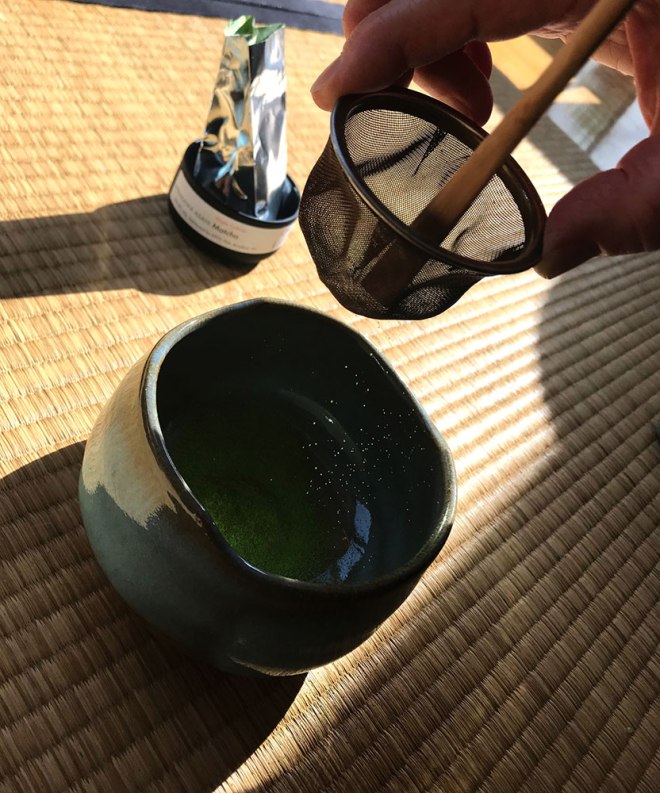
So, on Leap Day, we selected tea and various utensils in advance and set the basic premise for Leap Tea. But we decided that the remainder of the tea process would be co-created, with Tattfoo, within the duration of the micro-production’s unfolding, and in response to the variables of the day. Together, we would invite and enable various configurations of elemental forces (tea, water, heat, day, season, humans, fire, utensils) and attempt to taste and enjoy the difference the would emerge.
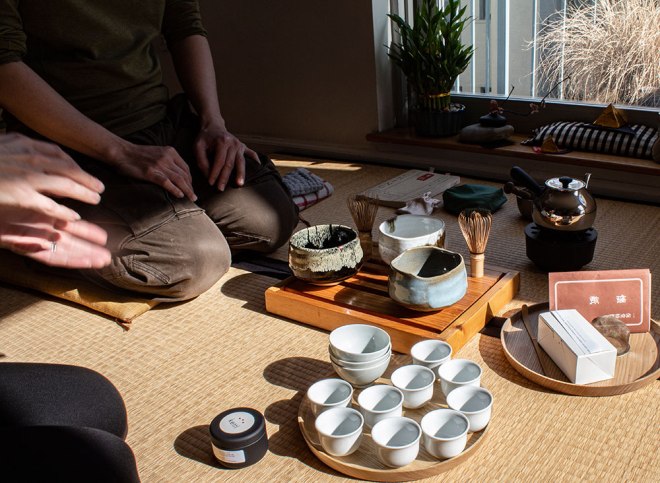
We originally intended to meet at Central Park on the afternoon of the 29th. But when the weather forecast reported 20mph winds and a high of 35 degrees, we collectively decided on morning tea at our apartment. Tattfoo arrived at 10am, February 29, 002020.
Upon his arrival, we paused to sense the sun streaming onto the stage of our micro-production, the warmth of the apartment, and the beginning of our time together. While enjoying a tea sweet, we decided that we would make three bowls of matcha by rotating the production elements for making each bowl among us. This would give each of us a chance to “read” and creatively respond to each of the steps in the process: scooping and straining the tea; measuring and pouring the water; and whisking. In this way, we co-created the three bowls of tea.
For the first bowl, Liz sifted an unmeasured quantity of matcha, Jamie decided the quantity and temperature of the water, and Tattfoo whisked the tea for a duration invented through the process. We poured this bowl into three small cups and tasted the alchemic unfolding of this configuration of tea, water, heat, whisking, and its duration. For the second bowl, Jamie added tea, Tattfoo added the water and Liz whisked. The second bowl of matcha was remarkably different, perhaps better, than the first. For the final bowl, Tattfoo scooped the tea, Liz added water and Jamie whisked. The differences among the three bowls was distinct.

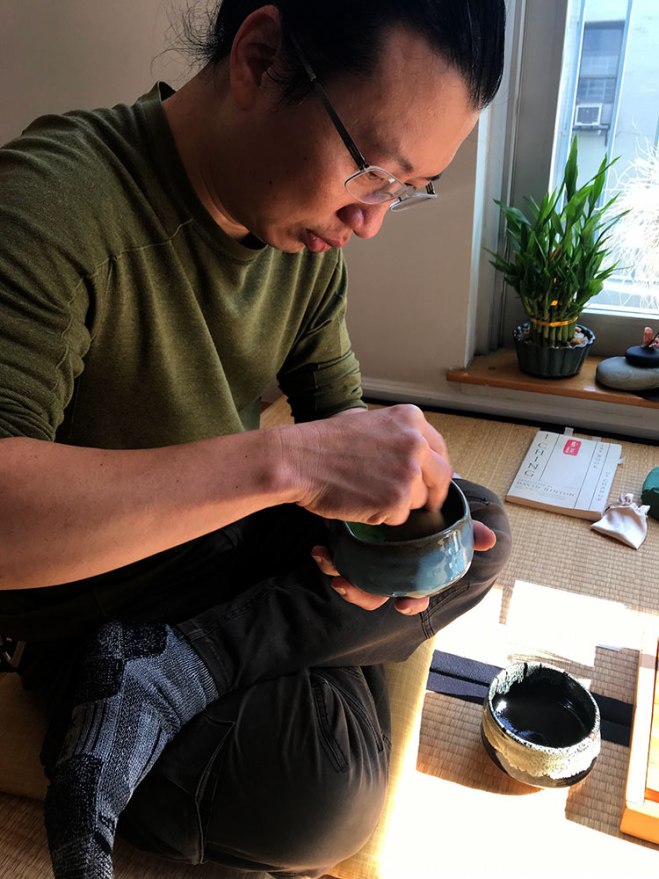

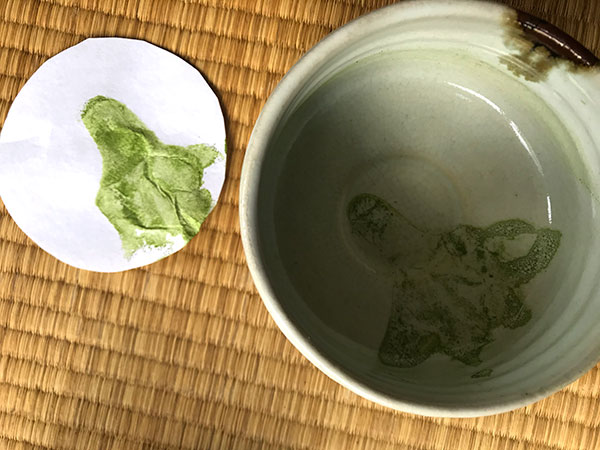
After drinking the tea, Tattfoo offered a reading the tea leaves which, in this case, consisted of traces of matcha foam left in the bowl. Rather than a personal divination, the reading was offered as a response that could inform collective strategies for meeting the Anthropocene.
Tattfoo responded to the traces by suggesting that the part of the micro-production that was the making and drinking tea could be seen as “life.” And the material traces that remained in the bowl could be seen as “death,” in the sense that the stains/traces were material artifacts of what had been lived/drunk. He added that, in spite of the interpretation he offered, the material traces left in the bowl are actually empty of meaning — in the sense that they are empty of such human stories and interpretations, as is life.
In the context of Leap day, fixing meanings and interpretations to the change-event that is tea (and all other things) is a bit like the grid of the Gregorian calendar. It tries to “fix” or capture what is, in fact, ongoing dynamic change.
In our invitation, we had offered Tattfoo the Chinese concept of shi/勢 (propensity of things) as a concept we might use to inform the micro-production. For us, shi is a useful term for illustrating the space/time waves that pass through us and all things in the Anthropocene, shaping the propensities and dispositions of the tea foam left in the bowls.
With this concept in mind, in the days before Leap Tea, we had experimented with creating “stamped” impressions of matcha “tea leaves” onto washi paper. We have enjoyed how these impressions have changed color and density as days pass. Their transformation in color and texture illustrate the duration of their ongoing interaction with the air, light and time. After Tattfoo’s reading, we each pressed a circle of washi paper into our bowl. We look forward to seeing how these traces continue to change in coming days, and we appreciate how they are a reminder that the tea we ingested continues to change through, and with, us.
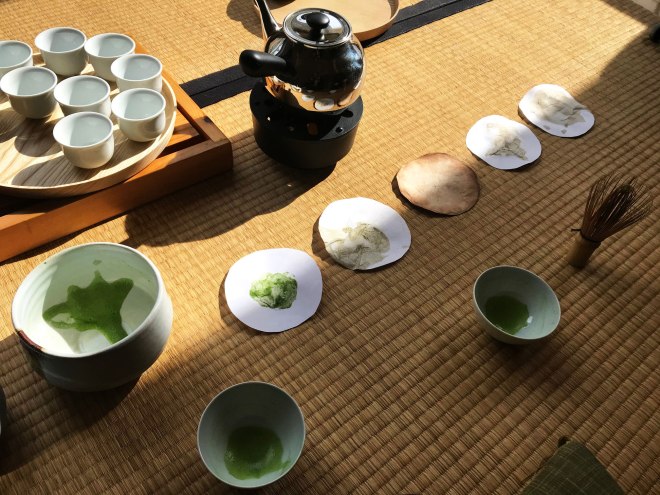

We finished Leap Tea sensing that a useful skill, or awareness, to develop within the Anthropocene is the ability to see, experience, and embody the changing of patterns and their singularities—and co-mingle with that change. There is no fixed pattern or recipe to get “right” — “right” is simply reading the shi of the conditions of making the tea, living/drinking the resulting configuration with attention — and moving on. Otherwise, in the words of the I-Ching, patterns are likely to become bitter and exhaustible.
As the Pattern hexagram suggests, “navigating danger” or change by “using delight” could mean allowing time to become aware of change itself. Perhaps this makes the going slightly less dangerous. Perhaps, if we follow the changing lines that exist in all patterns, we might transform the lines of our lives’ unfoldings in the Anthropocene into a version the I-Ching‘s Heaven hexagram.

“All origins penetrating everywhere, heaven is inexhaustible in bringing forth wild bounty. How vast and wondrous the heaven of origins! The ten thousand things all begin from it It governs the sky — the movement of clouds, the coming of rain. It give all the various things their distinct forms. How vast its illuminations of ends and beginnings! When the potent places of these six lines are realized in their proper seasons, the seasons mount the six sun-dragons and soar through the sky. The Way of heaven is all change and transformation at the hinge of things, where the unfurling nature of each thing itself is perfected. It nurtures vast harmony in wholeness, and remains inexhaustible in bringing forth wild bounty. When its dragon-head rears up among the innumerable things, it unites the ten thousand kingdoms in wholeness and peace” – Heaven #1, – from I-Ching: The Book of Change, translated by David Hinton
* all images this post FOP 002020
Additional Leap Tea details posted on our digital Chakaiki 茶会記 page.
 FOP
FOP 